
Blind tennis
Next sessions
Tennistreenit Talissa
Talin tenniskeskus, Kutomokuja 4
Sign up for practiceTennistreenit Helsinge Skolalla
Helsinge skola, Ylästöntie 3, Vantaa
Tennistreenit Talissa
Talin tenniskeskus, Kutomokuja 4
Sign up for practiceTennistreenit Helsinge Skolalla
Helsinge skola - Ylästöntie 3, Vantaa, Ylästöntie 3, 01510 Vantaa, Suomi
Sign up for practiceTennistreenit Talissa
Talin tenniskeskus, Kutomokuja 4
Sign up for practice
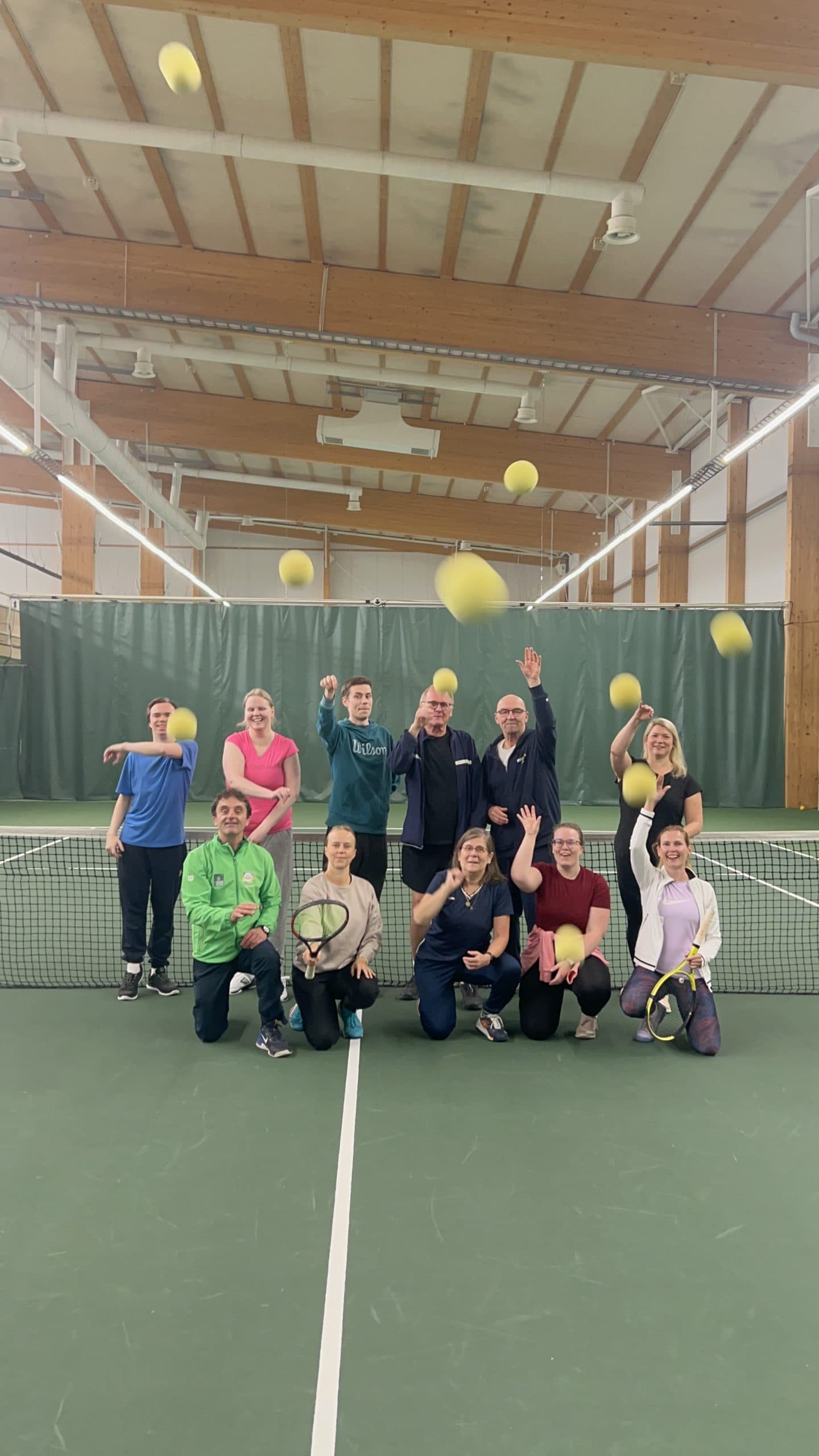
History was made in September 2024, when Aisti Sport, together with the Finnish Tennis Association, the Tali tennis centre and HVS-Tennis, ran the largest blind tennis taster event ever held in Finland. Blind tennis is one of the fastest growing sports for visually impaired athletes, and the hope is that it will soon appear on the Paralympic programme too.
The taster event in Finland was led by the Irish coach Wesley O'Brien, who back home is a long-standing national team coach for blind tennis and an advocate for the sport. He gave personal coaching to the nearly 40 participants who attended, trained the volunteer assistant coaches in the finer points of the sport, and taught the correct court markings so that the sport can continue to be played here in the future. You can read more about the taster event and the visitors' experiences via the following links, for example:
Watch a round-up of the taster event on our Facebook or Instagram video.
The basics of blind tennis
In blind tennis, unlike traditional tennis, the ball is larger, made of foam and rattles. The ball is also black or yellow, depending on the floor. Completely blind players in class B1 and severely partially sighted players in class B2 are allowed 3 bounces, B3 players 2 bounces, and the least severely partially sighted players in class B4 1 bounce. Blind players also use a smaller court, a slightly lower net, and court boundaries that can be felt by touch, in the style familiar from goalball.
Rubber raised markers ("tactiles") can also be used to help mark out the tennis court, and these are available at the Tali tennis centre among other places. They can also be used when rallying to mark the centre and the sides, even if you do not feel up to taping the whole court. More detailed rules and, for example, the exact dimensions of the B1 and B2–B4 courts can be found on the International Blind Tennis Association (IBTA) website.
Tips for practising on your own
Here are some introductory drills shared by Wesley O'Brien at our taster event on 21–22 September 2024.
It is worth starting a session with drills designed to get a feel for the ball and how it moves on court. The foam ball rebounds a little differently from a traditional tennis ball, and getting used to anticipating it is a good way to warm up.
Players can first throw the ball to the ground themselves and catch it on the first, then the second, then the third bounce, so that they get a clearer sense of how high the ball bounces. After that the ball can be thrown between partners, with the partner first saying whether they are aiming to the catcher's left, straight at them or to their right, and then doing the same without saying the direction. As the drill progresses, new conditions are added — for example setting the aim of catching the ball on the first, second or third bounce, with either the thrower or the catcher announcing the target before the throw.
Another drill done over the taster weekend was based on tracking the ball's movement on court. Instead of trying to catch the ball, one player moves to the spot on court where they hear the ball's first, second or third bounce land. The purpose of this drill is to build a sense of the ball's trajectories in relation to the court and the player.
After these, you can move on to practising with a racket. With a racket you can start with the same drills: the ball is stopped on an agreed one, two or three bounces, and then hit away after a given number of bounces.
After that you can move on to serving drills, and the next stage is rallying. An official start to play goes like this: the server asks "Ready?", the other player answers "Yes!", and the server finishes by saying "Play!" before striking. In tennis the serve always goes crosscourt. The tennis court is divided into two boxes, A and B, on each side of the net, and the server always serves from behind the baseline, crosscourt into one of the opposite boxes.
Our training
Our training is intended for players of all ages and levels, inexperienced and experienced alike. Our coaches run the sessions according to who is taking part. The coaches are the hugely enthusiastic Ilkka Iso-Keisari and Riccardo da Sacco.
How do you get started on your own?
Practising on your own is possible all over Finland. Blind tennis balls and rackets can be rented at the Tali tennis centre, and at Aisti Sport you can borrow both balls and rackets donated by the Finnish Tennis Association, and even a portable tennis net. Rackets can also be rented from tennis centres. Booking a court is easy online, for example. You can also order your own balls to be delivered to your home. Have a look at the online shops below.
Buy tennis balls at Tali or order them for yourself from online shops
At the Tali tennis centre you can buy Handi Life Sport blind tennis balls (version 3.0) at 9,50€ each (2 for 18€). You can also order various kinds of blind tennis balls from online shops.
In the Handi Life Sport balls, the jingle of the ”bells” inside them is a more dominant sound than in the others, where the sound of the balls' ”bells” is more of a light tinkle.
Caught the bug? Get in touch with us!
We are glad to help you find the right contacts and to tell you about upcoming tennis events as soon as we know of them.
Contact person: Satu Saarimaa
For urgent matters by phone, Markus Tihumäki 044 569 6298.
Follow Aisti Sport on social media so you do not miss upcoming tennis events and announcements.
Aisti Sport Instagram
Aisti Sport Facebook
Our email
Our training schedule, price and signing up
- Schedule
Mondays 17 August – 14 December 2026 17.30–18.30 Tali tennis centre (Kutomokuja 4, Helsinki)
Wednesdays 12 August – 16 December 2026 19.30–21.30 Helsinge skola (Ylästöntie 3, Vantaa)
- Price
Training is priced per session and is generally invoiced by email at the end of the season. Single session 9,50€ (Aisti Sport ry members -10%) Season cap (autumn or spring) for training 1x/week 142,50 € (members 128,25 €) and 2x/week 220 € (members 198 €) For anyone trying it for the first time, the 1st session is free.
Both sessions include coaching. If you need to borrow a racket, please tell us in advance so we can make sure one is available for you. Where possible, we especially encourage B1 participants to bring along a friend with more sight, who can also help retrieve balls during training if needed. This is not in any way compulsory, however.
- Enquiries
Satu Saarimaa